Endgame
Season 2 Crafts Spend the Same Crests as Four Upgrades
Midnight's Season 2 crafting table removes enchanted crests, but high-track crafts still cost 80 regular Mistcrests. That makes every early craft a gearing decision, not a free shortcut.
Season 2 is removing a step from high-end crafting, not its price.
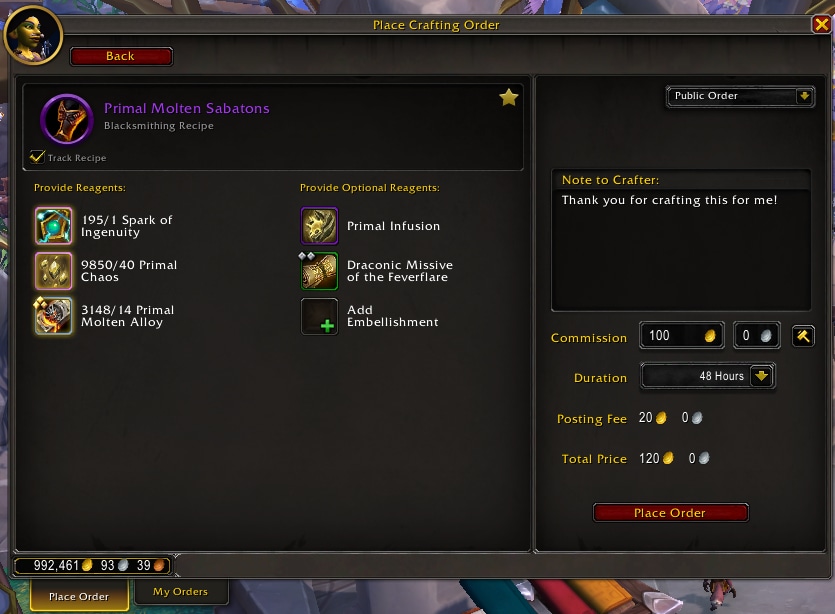
On the current Patch 12.1 tables, Hero and Myth crafts no longer ask for a separate enchanted crest. The customer places 80 regular Mistcrests of the matching track directly into the craft, along with two Sparks of Tides for most armor and one-handed weapons or four Sparks for a two-handed weapon.
That sounds cleaner because it is cleaner. It is also easy to misread as cheaper.
With a 100-crest weekly cap and a flat 20-crest price for one ordinary upgrade step, an 80-crest craft consumes the same weekly currency as four upgrades on dropped gear. A player who commissions a high-track item as soon as the materials exist is choosing one deterministic slot over four immediate upgrade steps elsewhere.

The enchanted crest is gone; the tradeoff is not
Recent WoW seasons put an extra object between the player and a high-level craft. Ordinary crests went into an enchanted crest, usually through an Enchanter, and that finished reagent went into the order.
The Season 2 PTR table lists the ordinary currency directly:
| Craft target | Current listed seasonal cost |
|---|---|
| Adventurer | 80 Adventurer Mistcrests |
| Veteran | 80 Veteran Mistcrests |
| Champion | 2 Sparks of Tides for most items; 4 for a two-handed weapon |
| Hero | 80 Hero Mistcrests plus 2 or 4 Sparks of Tides |
| Myth | 80 Myth Mistcrests plus 2 or 4 Sparks of Tides |
There is no separate enchanted-crest commission in that flow. Fewer handoffs mean fewer ways to buy the wrong reagent, mail it to the wrong character, or reach the order screen without the item the recipe expects.
The currency decision has moved into clearer view. The same Hero Mistcrests that raise Hero-track drops are also the material for a Hero craft. The same Myth Mistcrests that move a Myth item are reserved by a Myth craft.
Eighty crests equals four upgrade buttons
Season 2's current upgrade table charges 20 matching crests per item-level step. Each crest type is capped at 100 earned per week.
That makes the early arithmetic unusually clean. Spend 80 on a craft and 20 remain from a fresh cap. Spend the same 80 on upgrades and four pieces can each move one step, one item can move four steps, or the currency can be divided around breakpoints.
The comparison is not simply one item against four items. A craft offers control that a random drop does not:
- the exact equipment slot;
- chosen secondary stats through a missive;
- a planned embellishment where the recipe allows one;
- protection from losing the same slot roll again;
- a base item that can be recrafted later.
That control can easily be worth four upgrade steps when the crafted item anchors a build. A weapon, a high-value embellishment, or a slot with poor raid and dungeon alternatives can improve more than its item level suggests.
It is poor value when the player is crafting simply because the currency exists. If several dropped pieces are waiting for upgrades, spending 80 crests on a temporary armor slot can delay power across the entire character.
Sparks set a second clock
Sparks of Tides are used directly rather than assembled from two fragments. Current references list one Spark earned per week, with catch-up progress tracked through Tidal Spark Dust for characters behind the seasonal maximum.
The whole-Spark presentation is straightforward, but item costs still create a wait. Most crafted equipment asks for two Sparks. A two-handed weapon asks for four.
Do not build a calendar from the tooltip alone. Patch week, the season-opening week, catch-up behavior, and any one-time quest rewards can change the date a character actually holds two or four Sparks. The safe plan is to inspect the live reagent count before promising a raid group that a weapon will be ready on a particular reset.
Spark timing and crest timing can also miss each other. A character may have enough Sparks for a Champion-range base before earning 80 Hero or Myth crests. That creates a legitimate staged path: make or promote the base when it solves an immediate problem, then add the higher crest track in a later recraft.
Staging is not automatically efficient. It adds another order, more ordinary materials, and another crafter interaction. Use it when the interim item will see real play, not merely because the interface permits it.
Pre-crafting does not prepay Season 2
One popular preparation idea is to craft every possible Season 1 base while materials and Season 1 currency are plentiful, then promote the winners after rollover.
That can hedge ordinary material prices. It does not hedge seasonal power.
Moving an item into Season 2 still requires the Season 2 Spark. Adding the Hero or Myth range still requires the new 80-crest reagent. The previous item level does not waive either limit. If a cheap base is never selected for the live build, its only achievement was consuming materials early.
Look at the Season 2 raid and dungeon tables before filling the bank with speculative crafts. Identify the slots with weak alternatives, the embellishments the character expects to keep, and any tier slots that should remain flexible. Pre-craft only when the saved base materials justify the risk that the item never receives a new Spark.
Recrafting is not paying the whole bill twice
The opposite misconception is just as expensive: players see an optional Spark and an 80-crest slot in the order window and assume every quality recraft consumes them again.
Use the dedicated Recraft tab and select the existing item. A routine same-season recraft can improve quality or adjust allowed choices while retaining the power reagents already attached to the item. New Sparks or crests are required when the player is replacing the season, adding a higher track, or otherwise changing that reagent—not simply because a crafter presses the recipe again.
The live preview is the final bill. If it shows another seasonal reagent being consumed during what should be a routine quality correction, stop before placing the order and check that the old Spark or crest has not been manually removed or replaced.
Spend deterministic currency on a deterministic problem
The strongest first craft solves something the loot table is unlikely to solve cleanly.
Start with the raid, dungeon, and Great Vault alternatives for the slot. Check whether the character needs tier there. Compare the embellishment against the effect already equipped. Sim the stat choice when the difference matters. Then count the ordinary upgrades that the 80 crests would postpone.
A practical order looks like this:
- 1. Lock the slot and embellishment plan.
- 2. Confirm whether the recipe costs two Sparks or four.
- 3. Wait until the character actually owns the live-season reagents.
- 4. Compare the craft with four matching-track upgrade steps.
- 5. Place the order only when the deterministic item wins that comparison.
The removal of enchanted crests makes the system easier to understand. It also removes the visual distance between crafting currency and upgrade currency. The crests in the order window are the same power budget that could have been spent across the rest of the sheet.
Season 2 crafting is still one of the best ways to fix a stubborn slot. Just make sure the slot is stubborn before spending four upgrades on it.